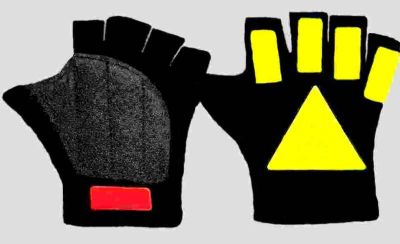
I first saw GloGlovs being used by
Washington State Ferry workers. A nice lady named Lynette Waneke Gray
makes GloGlovs down in Oregon and you can go to her website at:
http://www.gloglov.com/
to find out more.
Base Layer
For my base layer I tend to favor thin wool jerseys or wool t-shirts. Some folks prefer various wicking synthetics, although some synthetic fabrics like polypro have a nasty tendency to retain odors. For years climbers have sworn by Patagonia's Capilene and the Patagonia folks worked hard to make Capilene into a "stinkless" synthetic. The one fabric that I really try to avoid for cycling wear is cotton. A cotton t-shirt is fine for warm summer days but in the winter it just gets wet and clammy and sucks all the heat away from you.
For pants I wear lycra cycling shorts under Suplex nylon shorts or pants. I also use lycra arm and leg warmers depending on how warm or cold things are. In the spring and fall, it's often cool enough in the morning for long sleeves but much warmer by the time the evening commute rolls around. Arm and leg warmers take up much less space in a pack than full tights and a long sleeve jersey.
Shells and Pants
When it's wet or cold I wear a shell layer, either a jacket or a vest. My rain jacket is yellow. My vest is yellow. I'm not particularly fond of yellow but it is a very noticeable color. Bright orange or lime green are good as well but I always advise people to get rain gear in bright colors. I see people commuting in dark blue or black jackets and they just blend in with the rain. If you do have a favorite dark jacket (and I have a black Marmot windshirt that's just great!) wear it with a bright vest or a reflective sash.
As for specific jackets, I really like a very cheap, light jacket called the Rainshield O2. Their $35 jacket works surprisingly well and it's about the lightest rain jacket on the market. I also have their heavier, pricier jacket and it's also quite good. A company called Burley just restructured and won't be making rain wear anymore but their jackets are very good and many commuters swear by them. So if you want a Burley, get 'em while you can. Showers Pass makes good stuff as well and so does Jackson & Gibbons. If you get up to Canada, check out some of the jackets at MEC and locally REI has a pretty good selection of jackets.
I really haven't found a true rain pant that I like. The problem is, it's mostly too warm hear and most rain pants get to clammy. Goretex may be waterproof and breathable if you aren't too active but I find that for cycling it tends to get overwhelmed trying to vent sweat and so I get clammy. For jackets I prefer things that are more breathable (or have big vents and arm-pit zippers) and for my legs I either just use lycra leg warmers or warmers together with nylon chaps called Rainlegs.
I reviewed a few items for the Ultra Marathon Cycling Association, including the Rainshield O2 and Rainlegs and you can read those reviews here:
http://www.ultracycling.com/equipment/foul_weather_gear.html
Feet
I wish I could tell you the secret to keeping your feet warm and dry on a wet commute, but I don't have a perfect solution. As I've found with gloves, I can be fairly happy albeit somewhat damp by using a layer of wool. I wear wool socks all the time. Depending on conditions I may over layer the wool with a Sealskins sock or some kind of over-boot but ultimately water seems to seep. I have friends who swear by the combination of Shimano sandals, wool socks and a Goretex over sock.
Probably the best advice I can give you is to have a spare pair of socks. Few things match the luxury of slipping into a pair of dry socks at the end of a wet commute. And I figure you've already worked out that it's best to leave your work shoes at work, right?
Finally, reflective ankle bands are another cheap but very noticeable addition to the cyclists wardrobe. The flash of yellow or orange draws the eye and the spinning motion helps drivers identify that flashing thing up ahead as a cyclist.
Final Advice
Remember that everyone's visibility is lowered in the rain. Even if it's daylight, I tend to turn my lights on in the rain. When it's wet, slow down. Not all your fellow riders may be as well lit as you and wet roads can be treacherous. Watch out for man-hole covers, railroad tracks, metal bridge decks, painted fog lines and leaves. All these things can be wickedly slippery when wet. Be careful out there.
http://www.gloglov.com/
to find out more.
Base Layer
For my base layer I tend to favor thin wool jerseys or wool t-shirts. Some folks prefer various wicking synthetics, although some synthetic fabrics like polypro have a nasty tendency to retain odors. For years climbers have sworn by Patagonia's Capilene and the Patagonia folks worked hard to make Capilene into a "stinkless" synthetic. The one fabric that I really try to avoid for cycling wear is cotton. A cotton t-shirt is fine for warm summer days but in the winter it just gets wet and clammy and sucks all the heat away from you.
For pants I wear lycra cycling shorts under Suplex nylon shorts or pants. I also use lycra arm and leg warmers depending on how warm or cold things are. In the spring and fall, it's often cool enough in the morning for long sleeves but much warmer by the time the evening commute rolls around. Arm and leg warmers take up much less space in a pack than full tights and a long sleeve jersey.
Shells and Pants
When it's wet or cold I wear a shell layer, either a jacket or a vest. My rain jacket is yellow. My vest is yellow. I'm not particularly fond of yellow but it is a very noticeable color. Bright orange or lime green are good as well but I always advise people to get rain gear in bright colors. I see people commuting in dark blue or black jackets and they just blend in with the rain. If you do have a favorite dark jacket (and I have a black Marmot windshirt that's just great!) wear it with a bright vest or a reflective sash.
As for specific jackets, I really like a very cheap, light jacket called the Rainshield O2. Their $35 jacket works surprisingly well and it's about the lightest rain jacket on the market. I also have their heavier, pricier jacket and it's also quite good. A company called Burley just restructured and won't be making rain wear anymore but their jackets are very good and many commuters swear by them. So if you want a Burley, get 'em while you can. Showers Pass makes good stuff as well and so does Jackson & Gibbons. If you get up to Canada, check out some of the jackets at MEC and locally REI has a pretty good selection of jackets.
I really haven't found a true rain pant that I like. The problem is, it's mostly too warm hear and most rain pants get to clammy. Goretex may be waterproof and breathable if you aren't too active but I find that for cycling it tends to get overwhelmed trying to vent sweat and so I get clammy. For jackets I prefer things that are more breathable (or have big vents and arm-pit zippers) and for my legs I either just use lycra leg warmers or warmers together with nylon chaps called Rainlegs.
I reviewed a few items for the Ultra Marathon Cycling Association, including the Rainshield O2 and Rainlegs and you can read those reviews here:
http://www.ultracycling.com/equipment/foul_weather_gear.html
Feet
I wish I could tell you the secret to keeping your feet warm and dry on a wet commute, but I don't have a perfect solution. As I've found with gloves, I can be fairly happy albeit somewhat damp by using a layer of wool. I wear wool socks all the time. Depending on conditions I may over layer the wool with a Sealskins sock or some kind of over-boot but ultimately water seems to seep. I have friends who swear by the combination of Shimano sandals, wool socks and a Goretex over sock.
Probably the best advice I can give you is to have a spare pair of socks. Few things match the luxury of slipping into a pair of dry socks at the end of a wet commute. And I figure you've already worked out that it's best to leave your work shoes at work, right?
Finally, reflective ankle bands are another cheap but very noticeable addition to the cyclists wardrobe. The flash of yellow or orange draws the eye and the spinning motion helps drivers identify that flashing thing up ahead as a cyclist.
Final Advice
Remember that everyone's visibility is lowered in the rain. Even if it's daylight, I tend to turn my lights on in the rain. When it's wet, slow down. Not all your fellow riders may be as well lit as you and wet roads can be treacherous. Watch out for man-hole covers, railroad tracks, metal bridge decks, painted fog lines and leaves. All these things can be wickedly slippery when wet. Be careful out there.