Note: I wrote this article back in 1998 and it originally was published
in the May/June 1998 issue of Recumbent Cyclist New (RCN #45). I'm
reprinting it here with the kind permission of Bob Bryant. Bob continues to
publish Recumbent
Cyclist News and if you're at all interested in unique bicycles you
should check out RCN.
Joe and the Joetator
by Kent Peterson
Copyright © 1998 by Recumbent Cyclist International. Reprinted
with permission.
"My God, what is that thing?"
This reaction comes almost involuntarily to the lips of anyone who sees
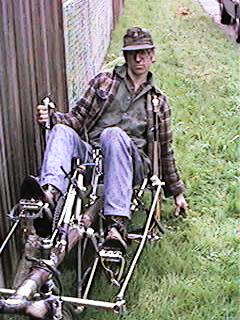
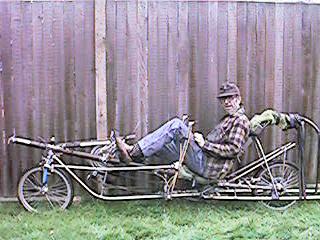
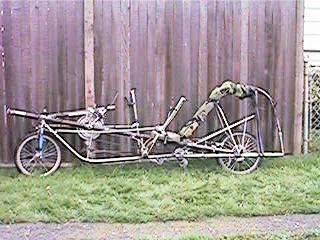
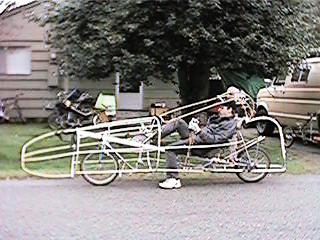
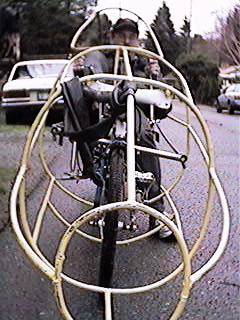
the bike we've dubbed "Joetator." Yes, we explain, it's a bicycle. 12
feet long, one hundred pounds, but still a bicycle. Somehow, I hadn't
thought it would turn out this way. It began, like many a misadventure,
as a simple plan. I'd seen the beautiful flowing lines of the Rotator
Pursuit in Recumbent Cyclist News and I'd read Bob Bryant's glowing
review. "Oh, yes," I'd thought, "it will be mine." The problem, as
usual, was saving up enough money to purchase this sleek antelope of
the asphalt. My money was mostly getting channeled into such
frivolities as food, a roof over my head, shoes for the kids and other
such nonsense. My pursuit of the Rotator was shaping up to be a
multi-year ride.
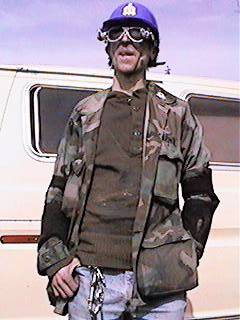
My buddy Joe Kochanowski had the answer, "I'll build you a bike," he
said. Now you have to understand that Joe is a genius. An absolute,
certifiable genius, like Thomas Edison or the guy who came up with the
idea of a TV show called "Xena: Warrior Princess." But Joe's medium is
electricity of TV programming, Joe sculptures in steel and he builds
bikes. Sure, most of his bikes are massive. scary looking things
but most people only catch glimpses of these bikes as Joe pilots them
at speeds more often associated with the oval race track at Indy than
the pot-holed streets of Seattle.
I began to warm to this idea. "Yeah, Joe's version of a Rotator...we'll
call it the Joetator. It'll be great!" My thoughts continued on. "Yep,"
I told myself, "when you're friends with Michelangelo, you don't put in
ceiling tile." Joe actually owns a Rotator Super Seven, one of the
legendary Rotator racers.
Of course, Joe has extensively modified his Rotator and he rode it
fully faired in last year's Seattle to Portland ride. One of the
thousands of people he passed was heard to mutter, "He's got a motor in
there." No, it's just Joe but Joe is enough. So Joe would take his
knowledge of the Rotator, mix it up with his street smarts and build a
super bike.
We talked a bit about money but talking money with Joe is like talking
about Harrier jets with an Amish farmer. He may be vaguely aware that
such things exist, but they really don't enter into his day to day
thinking. "I'll build it, you ride it and if you use it and like it and
use it, pay me whatever." Great, Joe has just invented the first
shareware bicycle. Well, at least on paper anyway. And that was step
one. Get a big piece of paper. Actually it was a chunk of an old
cardboard box Joe scavenged out of the trash. Joe scavenges everything.
When I first met Joe, I wondered if he was homeless. I later learned
that he lives in a house just north of Boeing Field, just south of
Seattle, in the industrial district. His house is packed with bike
parts and tools. And when I say packed, I mean packed. It looks like
the Tour de France crashed into an exploding oil rig and landed in his
basement. There are bikes, metal tubes, lathes, cut-off saws, wrenches,
old fairings, airplane drop tanks, oxygen cylinders, small to medium
caliber weapons, pedals, cranks, large vices, micro calipers, air
compressors, and enough miscellaneous hardware to build two stealth
bombers with enough left over to build a small chemical refinery and an
espresso machine. But we were starting simple. A big line drawn on the
cardboard where the main body tube would go. Here's where the bottom
bracket goes, the wheels wind up here, the seat goes here... "How long
are your arms?" Joe asks. "Huh," I reply as I distractedly try to
calculate the scrap value of the metal in the room. I'm beginning to
think Joe's net worth may be somewhere in the Bill Gates neighborhood.
"Your arms...HOW LONG ARE THEY?" Joe grabs my arm and a tape measure,
"I have to figure out where the steering goes and I want to make sure
you can touch the ground. You don't want to unclip at a light, you'll
just put your hand down." Joe takes a couple of readings, makes a few
marks on the cardboard and is on to the next problem.
Joe is good at solving problems, but he works at his own schedule.
Despite the presence of enough hardware to jumpstart the economies of
several Balkan republics, Joe would continually comb swap meets,
surplus stores and industrial dumpsters to find just the right part.
This went on for months. I managed to spend some time with my wife and
sons and got enough real work done to get a handle on that whole
food/shelter/clothing thing.
My recumbent fever had not lessened at all. I home-brewed a couple of
SWB bikes of my own (yeah, I'll get around to doing an article about
that someday!) and somewhere along the line I bought Bob Bryant's
ex-test Rocket. I got very used to seeing my lovely wife's eyes roll
heavenward and her head shake in disbelief as I explained my need for
yet another bike. But for some reason she loves me very much and I now
have this fleet of , well, let's call them "unusual" bicycles.
But Joe kept working. I'd get calls and questions and reports from the
lab. "The Pursuit has tiller steering, " Joe would say, "you don't want
that. I'm going with side sticks, OK?" "Sure, Joe. Build it the way
you'd want it." After all, I figured, Joe knows at least a thousand
times more about this than I do.
"You want rear suspension." Joe would lose points on Jeopardy because
he didn't phrase this in the form of a question. Joe had bolted the
period onto the nd of that sentence and then TIG welded it to be extra
secure. "I want rear suspension," I echoed like the Imperial Storm
Trooper in Star Wars saying "These aren't the droids we're looking
for." "This is winding up heavier than a Pursuit, but weight doesn't
matter once you're rolling..."
"Weight doesn't matter once you're rolling," I thought, "but how do I
get this thing rolling?" It's a few months later and I'm at Joe's. I'm
settled into a rollable Joetator. It's, um... an experience. "You'll
feel more secure once I get the rollcage done," Joe assures me.
"Rollcage?" I think for an instant but as I survey the pounds of tubes
and cables and metal bits that could be awkwardly pokey in a crash I
think, "you know, a rollcage is a pretty good idea!" Joe push-starts me
down his street. The Joetator has semi-conventional controls connected
in unconventional ways to a custom drivetrain and brakes that are
looking a little overwhelmed by the rest of the bike.
I'm a bit overwhelmed by the bike. OK, OK, I'm terrified. But I'm
rolling. In a straight line with a death grip on the side sticks. "You
can heave on those as much as you want," Joe says, referring to the
steering sticks, "You can't break 'em!" "No," I'm thinking, "nothing in
this bike is breakable with the exception of me..." But Joe has wrapped
me in various pads for my test flight and even without the rollcage
this bike has an "inside." I'm inside and the outside world is just
something I run over. The Joetator is picking up momentum. I do a
little course correction with the sticks but when I attempt my first
turn, I crash. It's very uneventful. It's like the bike is some kind of
big, stubborn hippo. I wanted to turn, it wanted to lay down. It won.
"It'll take some getting used to," Joe assures me.
"It'll take some getting used to," I assure him. But I get up and get
the bike rolling again under my own power. Ride... crash.... ride...
crash... ride... ride... crash..., I'm getting the hang of this...
crash... ride... ride... this ain't so bad... ride... ride... I get so
I can navigate the industrial-sized streets of Joe's neighborhood. I
ride back to his place and crash in his driveway. "Hmm, you need more
practice," Joe discusses final tweaks and plans for the
rollcage/pairing frame. "It's just a little more work..."
Six weeks later I took delivery of the Joetator. Part of the
reason for the delay was working out the logistics of delivery. You
just don't strap a twelve foot long bike to the roof rack of a VW Jetta
and go. No, this is a deliberate process.
There was no way I was ready to pilot the Joetator the twenty-something
miles from Joe's industrial neighborhood in south Seattle to my house
in the suburban foot-hills of the Washington Cascades. And Joe wasn't
volunteering to ride the beast up to my burbclave either. Maybe the
climb along the north edge of Cougar Mountain was making him pause.
Maybe it was just his distrust of neighborhoods where coffee shops
outnumber machine shops.
Our pal Tony Licuanan solved this problem. Tony has a van. And it's not
one of those delicate shuttle-a-few-kids-to-little-league minivans
either. No, this is a VAN, an old Ford built like gas still cost
twenty-five cents a gallon and designed on the theory that vans are
used for bringing eight burly guys and all their gear up to
construction sites in the Alaskan wilderness.
So Joe, Tony and Steve Nash managed to coax the Joetator into the van.
It was a tight fit. When they showed up at my house one Saturday
morning, the Joetator was squeezed in diagonally with it's tail flush
with the left rear door and its nose draped over the passenger side
front bucket.
Steve had ridden all the way over with his head poked up between the
fairing frame tubes. He looked like Hannibal Lector being escorted to
the maximum security ward. The combined efforts of Joe, Tony, my friend
Kevin Coughlin, and myself were applied to the problem of extracting
the Joetator from the van without beheading Steve. I'm happy to report
we were successful. I stood there looking at my new bike. It didn't
have a skin over the fairing (that was my finishing job) but it was
basically done. It was my bike now. I actually own another bike built
by Joe, I've seen various bikes he's built and I'd seen the Joetator in
various stages of its construction. You would think that this would
have prepared me. You would be wrong.
You remember how you saw the first "Alien" movie and it was pretty
scary and then you saw the second movie with the bunch of Aliens and
they were scary and then near the end of the second movie you saw the
Alien queen and you went "Oh My God!"? "Oh My God!," I said. "Yeah, it
turned out great, didn't it?" Joe said.. "Wow, it's... umm... big," I
stammered. "Yep," Joe flipped up the canopy. The Joetator looks like a
cross between a beached whale and a wingless fighter plane. The
fairing/rollcage makes it a bit tricky to get into, but I manage. Yeah,
it's like I remember but it seems so big. The feeling is the mirror
image of the feeling you get when you visit your old elementary school
and realize how tiny the desks are. We all have places to go and things
to do so I'm spared having to do too many minutes of my ride...
crash... ride dance in front of an audience. Later, it's early evening
and I'm alone with the bike. I approach it with caution, which is what
Joe himself recommends. "You can't let a bike like this go to your
head. Just because you can run over animals and smash into cars and
come out unscathed doesn't mean you should do stuff like that." Right,
I really shouldn't do stuff like that.. But the bike is big. Really
big. I realize that I'd always seen it on the wide streets of Joe's
neighborhood. In my neighborhood, it's a monster loose in the village.
Kids who regularly yell out "Cool bike, Mister!" as I whiz by on my
Rocket now cower in terror and hide behind their mother's skirts has I
lumber up to an intersection. I feel I should file a flight plan every
time I want to go for a ride.
On the first night I own the Joetator, I pull a muscle in my back as I
try to jockey it into my carport. "I thought these bikes were supposed
to be GOOD for your back," my lovely wife quips. She is not one of the
Joetator's biggest fans.
I never get used to the bulldozer steering of the side sticks. It's an
odd combination of sluggishness that suddenly becomes a fierce
over-steer. I try to explain this to Joe. "The steering sucks!," I
explain. Joe presses me for details. "Sucks how? Too slow, too fast,
what?" "Yeah!" I say, "that's it. It's too slow and too fast. At the
same time! Can you change it?" "Nah, I'll build you a new bike." That's
one problem with Joe, once he gets a new idea, he wants to build a new
bike, which explains his continuously expanding fleet.
But I've learned more about myself, too. The Joetator isn't a bad bike.
It's a great bike... but not for me. I like bikes to be little, fast,
cute, zip-around bikes. Joe likes vehicles. Big, fast, frightening ones
that are bikes, too, but a different kind of bike than what I ride.
A few weeks later it's the Seattle Bike Expo. The whole RCN gang is
there: Bob, Tony, Steve, Joe and me. My pal Mike Ewing had taken the
ends off a really big trailer to help me get the Joetator down to the
expo. It's being shown off along with various other bikes including my
latest toy, a tiny SWB low racer built by John Williams, raced at
Yreka, California in the '92 HPV event, retired, and then rebuilt and
customized by Tony Licuanan and now dubbed Pillow Bike (more on this
later).
I have no intention of bringing the Joetator back home with me. I have
to work up the nerve to tell Joe. I find him at the swap meet. I'm just
getting ready to launch into my "It's not the bike for me" speech when
Joe says, "Would you mind giving up the Joetator? Tony's got this buddy
who'd really like it. You know, it's not your kind of bike anyway,
you're more of a SWB guy." Like I said before, Joe is a genius.
A month or so later I met Richard Lanier. We started talking bikes and
then Richard starts describing his latest bike. "Joe built it. It's
amazing, about twelve feet long..." "You've got the Joetator!," I
interrupt, "How do you like it?" "Well," he says, "it's really
something. I've got to change the steering though...it really sucks."